

The Hidden Faculty: Why They Need Us
Part III: The pedagogical benefits and contributions of a neurodivergent educator


This is Part 3 of a 3- part mini-series called The Hidden Faculty, a series focused on acknowledging the neurodivergent educators who are “hiding” in plain sight.
Before reading this post, I recommend reading Part I: The Hidden Faculty: We Are Around Here Somewhere, and The AFFIRM Framework for Building Neuro-Affirming Schools for additional context of the Neuro-AFFIRMing School Community.
I think I did well with these groups of kids [because] I understand that they weren’t doing it on purpose, and they weren’t lazy.”
The Current State
The first two posts in this series focused on raising awareness of neurodivergent educators in schools.
Part I revealed these educators as a natural presence in schools since 15-20% of the population is considered neurodivergent. It is only logical that neurodivergent educators exist, even though they are talked about so little in research and in policy (Neca et al., 2020).
Part II highlighted part of the reason that this population has remained “hidden,” with participants from my dissertation noting the need to “mask” to fit into a school built for neurotypical minds. This has made supporting neurodivergent educators even more complex, as we are not yet aware of what supports would benefit them the most.
Now that we know neurodivergent educators exist and are a presence in our schools, I want to shift the focus to why we should care about supporting them, and more importantly, why we should care about designing schools where all minds thrive, adults included.
The Research
One of the most consequential findings in my research is that neurodivergent educators bring a unique perspective and skill set to classrooms, matching the literature on disabilities research that revealed their pedagogical contributions and benefits.
First and foremost, neurodivergent educators accept and embrace differences in students, as they themselves have been students in classrooms where they learned differently. Several participants revealed that they openly advocate for students with challenging behaviors and prefer to listen to a student’s perspective first before jumping to conclusions about behaviors.
One participant noted that they are “unintentionally drawn to students who are neurodivergent.” This echoes Burns and Bell’s (2013) research that noted teachers with disabilities more readily understand students with disabilities, with teachers even feeling more responsible for supporting their development.
Secondly, neurodivergent educators show increased empathy of students, desiring to be transparent, authentic, and open with them. Participants in my study noted that they want to be a role model for students, offering a safe space for students to be themselves. StEvens (2022) echoed this research from autistic teachers who want to be a role model for both autistic and neurotypical students.
Relationship-building also surfaced as an important practice for neurodivergent educators. One participant said they wanted “to see my kids, not just their grades, not just their problems.” Participants felt the need to advocate for students and to advocate for “behavior as communication.” Burns and Bell (2010) echoed this finding that teachers empathize with their students, striving to build relationships as a cornerstone of the classroom.
Beyond connecting with students, neurodivergent educators also naturally differentiate their content, as they themselves learn differently in classrooms. Participants in the study prioritize hands-on learning, exploration, and inquiry and struggle with scripted curriculum and lessons.
One participant emphatically stated, “If I’m bored, they’re bored.” We know from neurodiversity research that neurodivergent adults bring a different skill set to their work, and educators are no different. Khan et al. (2023) noted that neurodivergent individuals are often creative and innovative.
While most participants expressed they are natural differentiators, several participants reflected that they prefer order to chaos, labeling everything in the classroom, instituting scheduled breaks, and dictating movement patterns to protect their own sensory triggers.
The research is clear that neurodivergent educators contribute to classrooms, and it is vital that we continue to shift our schools to embrace the minds of all adults in the building.
The Systemic Shift
We have previously focused on Acceptance from The AFFIRM Framework for Building Neuro-Affirming SchoolsTM
Now, we will move to Focused on Strengths, which means it is our responsibility as leaders to focus on the strengths and contributions of a neurodiverse staff. And remember, neurodiverse is all of us. Neurodivergent are those who deviate from neurotypical patterns of thinking and processing.
A neuro-affirming school recognizes all ways of thinking and learning to build strengths-finding into common systems and practices.
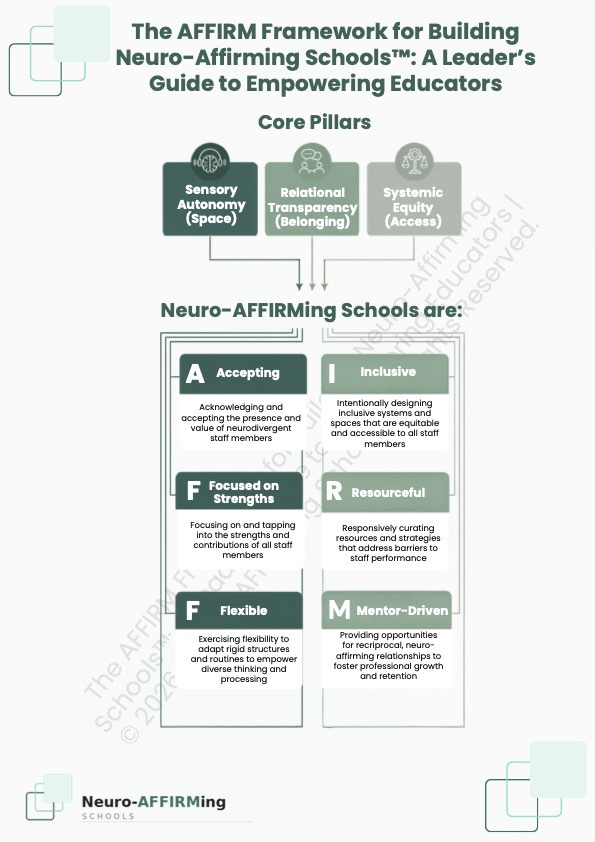
So how do we show that we value the contributions of a neurodivergent staff? It starts with how we observe and support teacher performance.
Evaluations should focus on coaching teachers to be the best versions of themselves. This means recognizing what they do well and not just dinging them for what they miss.
Modifying existing evaluation rubrics is a good first step.
Show recognition and value of the intangibles (relationship-building, connecting with students, being present at school events). This could mean adding a comment box or a reflective area for teachers to note how they are supporting the social-emotional needs of students.
Delineate the importance of differentiation by measuring/noting when teachers use flexible seating, intentional movement patterns, visual reminders, and alternative texts/levels for students
Clearly show that a quiet and orderly classroom is not what administrators always (or ever) want to see when they perform an observation. Many teachers are worried that their classes will be considered “out of control” if we walk into a noisy classroom full of movement. Learning is still happening in those moments, and we need to note what that looks like and why it matters.
Clarify teaching expectations by ridding the rubric of subjective adjectives. If there are instructional strategies that the entire school is striving to use, then clearly note the success criteria if these strategies are implemented. Clear is kind.
These shifts in how we approach observations and evaluations can help acknowledge the contributions that neurodivergent educators make in the classroom.
“I know I’m so good at my job, but it also feels like I can’t do anything right, and that they put so much more focus on the things that I don’t do well.”
We can fix this. By acknowledging the strengths of what educators bring to classrooms, we not only build them up, but we also keep them in classrooms where they benefit our students.
Check out the foundational 3-part series, The Hidden Faculty,” exploring exactly who neurodivergent educators are and why we all benefit by their contributions in schools: Part I | Part II | The AFFIRM Framework
About the Data: The findings shared in this post are adapted from Exploring the Experiences of Neurodivergent Educators in Schools, a dissertation study performed at Texas Tech University as part of my Ph.D. program.
Qualitative data are drawn from semi-structured interviews with 14 neurodivergent K-12 educators across the U.S.
References:
Burns, E. and Bell, S. (2010). Voices of teachers with dyslexia in Finnish and English further and higher educational settings. Teachers and Teaching, 16(5), 529–543. doi:10. 1080/13540602.2010.507964.
Khan, M.H., Grabarski, M.K., Ali, M., Buckmaster, S. (2023). Insights into creating and managing an inclusive neurodiverse workplace for positive outcomes: A multistaged theoretical framework. Group and Organization Management, 48(5), 1339-1386. DOI: 10.1177/10596011221133583
Neca, P., Borges, M.L., Pinto, P.C. (2020). Teachers with disabilities: A literature review. International Journal of Inclusive Education, 1-19. doi:10.1080/13603116.2020.1776779
StEvens, C. (2022). The lived experience of autistic teachers: A review of the literature. International Journal of Inclusive Education: 1-15. https://doi.org/10.1080/13603116.2022.2041738