

The Hidden Faculty: The Cost of Fitting In
Part II: Why neurodivergent educators "mask" and what we can do about it


This is Part 2 of a 3- part mini-series called The Hidden Faculty, a series focused on acknowledging the neurodivergent educators who are “hiding” in plain sight.
Before reading this post, I recommend reading Part I: The Hidden Faculty: We Are Around Here Somewhere, and The AFFIRM Framework for Building Neuro-Affirming Schools for additional context of the Neuro-AFFIRMing School Community.
“I’ve masked for so long and so hard that it’s hard for me to separate my masked self with myself.”
The Current State
In Part I of this series, “The Hidden Faculty: We Are Around Here Somewhere,” the emphasis was on first acknowledging and accepting that neurodivergent educators exist. Before we can create neuro-affirming schools that support all ways of thinking and learning, we first need to acknowledge that adults are as neurodivergent as our students are.
Participants in my dissertation study explicitly noted their need to mask, or essentially hide their true selves, to make them feel like “they are a regular adult” or to “protect my own self…so I don’t have a conflict.”
Participants masked their characteristics to avoid negative attention or the social stigma that comes from being neurodivergent.
One participant noted that he had masked for so long that colleagues were surprised when he disclosed that he was autistic after many years of working at the school.
Neurodivergent educators mask in an attempt to fit in, keeping them invisible. While the first step in creating a neuro-affirming school is to acknowledge and accept the presence of neurodivergent educators, the second step is to begin creating environments where masking becomes unnecessary.
The Research
It is difficult to support a population that stays “hidden” due to feeling a lack of support or acknowledgement of their strengths and contributions. This leads to what is termed “masking.” Dr. Ludmila N. Praslova defines masking as “the act of suppressing or camouflaging neurodivergent traits, behaviors, or needs to fit into a neurotypical workplace culture.”
Dr. Praslova goes on to explain that masking is workplace survival and involves mimicking others’ behaviors in an attempt to fit in and hide natural expressions or sensory challenges.
Bridgette Hamsted, founder of NeuroJustice, defines masking as “the sustained suppression and substitution of your actual neurological presentation for one built to read as neurotypical.”
When neurodivergent educators are constantly trying to be read as neurotypical, they begin to not only lose sight of who they are, but they also lose the opportunity to showcase how their divergent thinking and learning positively contribute to the classroom.
Research from StEvens (2022) notes that autistic teachers remain hidden for fear of bullying and discrimination; however, Neca et al. (2020) note that when teachers with disabilities are acknowledged, they can help defy negative stereotypes to change the conversation on support.
The Systemic Shift
We continue to focus on Accepting from The AFFIRM Framework for Building Neuro-Affirming SchoolsTM
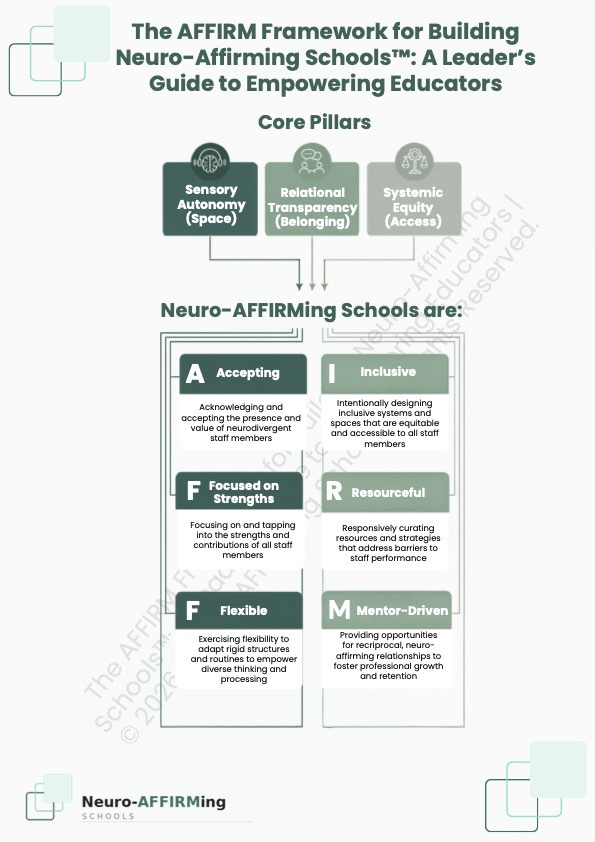
Without acceptance, neurodivergent educators will continue to mask to avoid social stigmas related to differences.
One of the core pillars of a neuro-affirming school is relational transparency. Relational transparency is based on clear communication and reciprocal mentorship.
Neurodivergent educators should not have to mask to fit in. When schools are neuro-affirming and difference is celebrated, all stakeholders can communicate in a way that supports and uplifts each other.
The framework rests on the belief that school environments must systemically shift practices to ensure all educators are supported, regardless of how they think and process.
To help neurodivergent educators unmask, the following practices are recommended:
Support Systems
Create affinity groups for neurodivergent educators to connect and support each other
Create a mentorship program to pair neurodivergent educators with experienced mentors to help them navigate the unwritten social norms and expectations in the building
Education and Training
Invite guest speakers to educate faculty members on neurodiversity to create systems of support among the faculty
Create opportunities for leadership to become trained in using neurodiversity-affirming practices to ensure equitable treatment and understanding of the needs of all educators
Clear Communication
Ensure communication is clear by putting expectations in writing via regular newsletters or email notices
Make use of bullets, bolded words, and checklists in all communication
Maintain a faculty handbook that is succinct and explicit, defining all school terms and expectations
These practices are a win-win for schools and leaders, as they ultimately benefit all educators by creating opportunities for clearer communication and connection.
Supporting neurodivergent educators means providing the opportunity for them to unmask and be their true selves.
Next up, Part III of The Hidden Faculty series: “The Hidden Faculty: Why They Need Us”
About the Data: The findings shared in this post are adapted from Exploring the Experiences of Neurodivergent Educators in Schools, a dissertation study performed at Texas Tech University as part of my Ph.D. program.
Qualitative data are drawn from semi-structured interviews with 14 neurodivergent K-12 educators across the U.S.
References:
Neca, P., Borges, M.L., Pinto, P.C. (2020). Teachers with disabilities: A literature review. International Journal of Inclusive Education, 1-19. doi:10.1080/13603116.2020.1776779
StEvens, C. (2022). The lived experience of autistic teachers: A review of the literature. International Journal of Inclusive Education: 1-15. https://doi.org/10.1080/13603116.2022.2041738