



New here? Check out the foundational series: The Hidden Faculty.
Perception is something that has to shift for sure, and that starts with adults (Osborne, 2025).
The Current State
In previous posts, I have written about the importance of systemic shifts to create a neuro-affirming school. These small shifts in practice can make a difference in the culture of a building.
Today, I stumbled upon a neuro-affirming moment during a PLC meeting.
Two of our high school teachers were in the throes of planning an upcoming unit, and I complimented them on their use of a visual poster to delineate where topics would be taught in the unit. I told them that I love the visual planning poster and noted that my brain works differently in that I need a more structured planning document. I love a good Google Doc with all of the lessons and resources hyperlinked in one place; I work very linearly and struggle with colorful visuals in planning.
One of the teachers commented that she is also a linear thinker and prefers a more structured document to plan from, but she recognized that her partner preferred the visual poster to help her organize her planning first. Her partner then commented that because they start with the visual, she goes back to their common structured planning document to note the changes and updates to benefit the other.
I was so impressed that these two teachers worked within their thinking and processing differences to create a planning system that worked for both of them.
Last year, I introduced neurodiversity-affirming productive struggle for students to the staff at my school, a session I later presented at the ASCD/ISTE Annual Conference this past July. During the session, we discussed neurodiversity and how our students need space, belonging, and access for meaningful learning to happen in a classroom.
Sound familiar? Space, belonging, and access are the core pillars of a neuro-affirming school…for both students and educators.
After witnessing today’s meeting with these two teachers, I am so excited to see that we are acknowledging each other’s differences and finding ways to build each other up to be stronger practitioners.
The Research
In The Hidden Faculty: The Cost of Fitting In, one of the research-based recommendations was to create an Accepting culture by educating and training staff on the core tenets of neurodiversity. The two suggestions presented were to invite guest speakers to educate faculty members and create opportunities for leadership to be trained in neurodiversity-affirming practices to ensure equitable support of educators and students.
Participants in the study noted a need for advocacy for neurodiversity, with one participant stating “there’s not enough understanding, not enough acceptance” (Osborne, 2025). It is difficult to accept differences in thinking and processing without first understanding that neurodiversity exists.
We are all neurodiverse. Some of us are neurodivergent and learn in ways that deviate from neurotypical individuals; however, all the ways of processing and thinking should be celebrated. Neurodiversity is just as biodiversity is.
Neca et al. (2020), in their literature review of teachers with disabilities, noted that advocacy can help reduce misperceptions and minimize negative stereotypes of disability. StEvens (2022) noted that autistic teachers provide an alternative perspective in an advocacy role, with Vogel et al. (2007) stating that understanding the lives of those with a disability can lead to valuable insights.
There’s just so much misinformation; there’s not enough science…not enough acceptance” (Osborne, 2025).
The Systemic Shift
The AFFIRM Framework for Building Neuro-Affirming SchoolsTM was created on the premise that all schools can be neuro-affirming by incorporating three core pillars and seven affirming principles into their school systems.
Within each of the seven AFFIRM principles are systemic shifts and actionable practices that directly impact an inclusive culture.
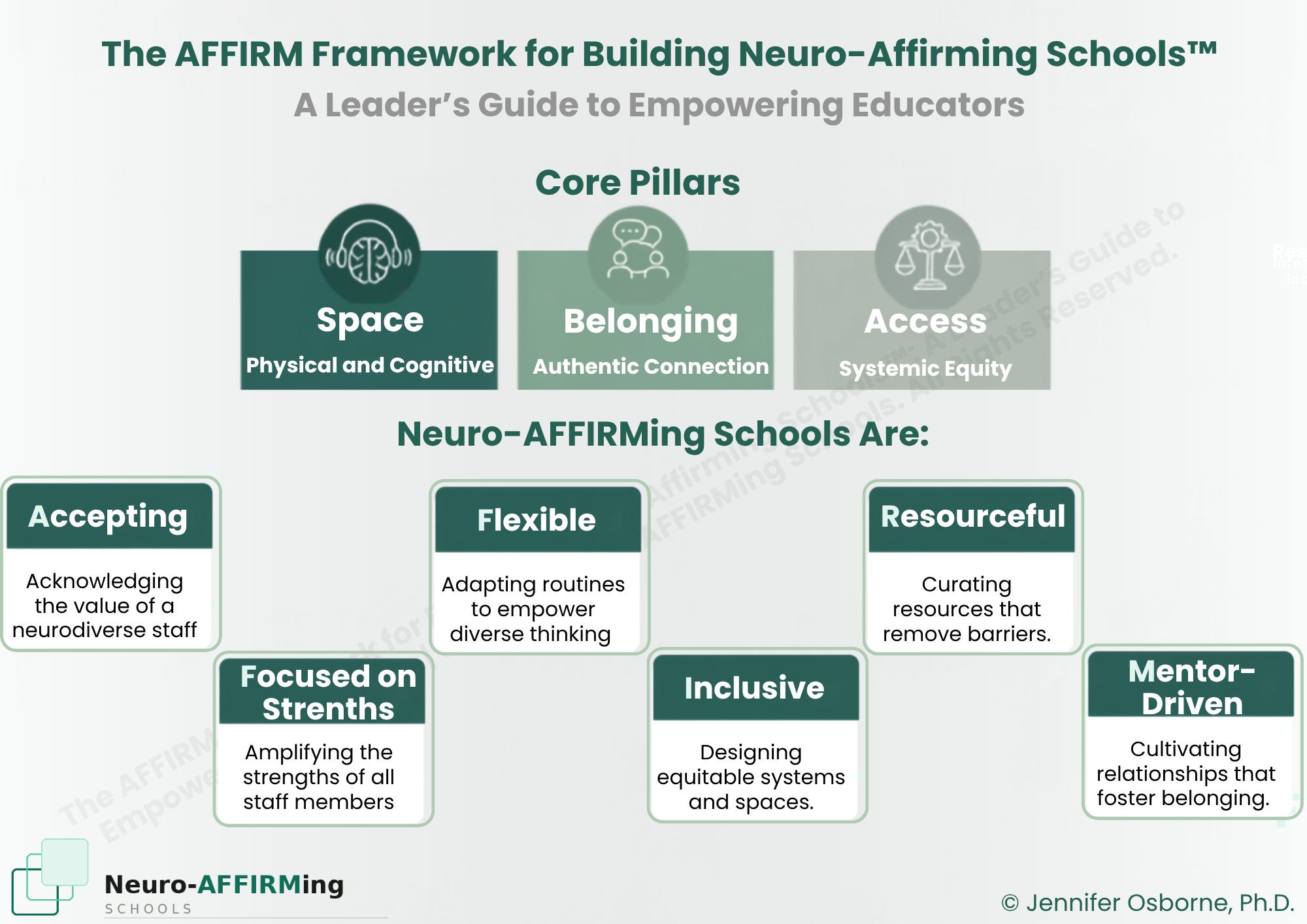
Under the core pillar of Belonging and the AFFIRM principle of Accepting, a key systemic shift is neurodiversity education.
Some actionable practices include:
Inviting guest speakers to educate all staff, and even the community, on neurodiversity
Create opportunities for staff to share their stories (i.e., neurodiversity panels, teacher-led sessions)
Educate school leaders on neuro-affirming principles and practices
Tech corporations are already leading this charge by actively training their employees on neurodiversity and actively recruiting a neurodivergent workforce.
Schools are places of learning, and I feel like we are often left behind in changes that shift the culture of other companies. We need to capitalize on our ability to be institutions of learning.
Providing education on neurodiversity is a small shift that can make a big difference.
Get the Playbook: Building a neuroaffirming school culture? Subscribe to receive The Playbook for Designing Neuro-AFFIRMing Schools.
Check out the foundational 3-part series, The Hidden Faculty,” exploring exactly who neurodivergent educators are and why we all benefit by their contributions in schools: Part I | Part II | Part III
About the Data: The findings shared in this post are adapted from Exploring the Experiences of Neurodivergent Educators in Schools, a dissertation study performed at Texas Tech University as part of my Ph.D. program.
Qualitative data are drawn from semi-structured interviews with 14 neurodivergent K-12 educators across the U.S.
References:
Neca, P., Borges, M.L., Pinto, P.C. (2020). Teachers with disabilities: A literature review. International Journal of Inclusive Education, 1-19. doi:10.1080/13603116.2020.1776779
Osborne, J. J. (2025). Exploring the experiences of neurodivergent educators in schools [Doctoral dissertation, Texas Tech University].
StEvens, C. (2022). The lived experience of autistic teachers: A review of the literature. International Journal of Inclusive Education: 1-15. https://doi.org/10.1080/13603116.2022.2041738