



This is Part I of Education, Disrupted: Systemic Shifts to Unlock Educator Strengths
New here? Check out the foundational series: The Hidden Faculty.
Get the Playbook: Building a neuroaffirming school culture? Subscribe to receive The Playbook for Designing Neuro-AFFIRMing Schools.
I could bring something into the classroom that other people aren’t doing and create a safe environment for students because I get them (Osborne, 2025)
The Current State: Am I Doing It Right?
Educator A: I walk by a classroom and hear a few kids shout in excitement, followed by a round of applause. I look into the door window, wondering what is happening inside. I see several groups of students at different tables working on some kind of puzzle or game. I come through the door and notice that students are actively struggling through a challenging activity at each station, working together to solve the problem. A few minutes later, the teacher cues them to rotate. They chat about the activity as they change stations.
Educator B: I walk by a classroom and hear a teacher’s voice through the door. I peek in the window. She is using a slide to introduce the start of a group activity. The slide has bulleted directions with a timer in the bottom section. The students are listening attentively. I come into the room and notice that stations are set up with activities at each table. The teacher cues the students to find their assigned groups. Students quietly find their stations and begin the activity, keeping the noise level to a requested two out of five.
Which one of these teachers is doing it “right”?
If you guessed that both educators are doing it “right,” then you would be correct!
Educator A prefers an environment with higher movement, discourse, and productive struggle. Educator B prefers more structure and routine when students are engaging in an activity with a designated noise level.
Both educators are actively engaging students in a way that works for their thinking and processing needs.
The participants in my dissertation study overtly discussed the desire to create active learning in the classroom, avoiding scripted curriculum, and seeking a way to engage students. This makes sense. Neurodivergent educators went through years of schooling, learning and processing differently than teachers might have recognized. Of course they want to find different ways to engage their own students.
However, each of the participants described different ways of encouraging active learning according to their own needs and preferences.
While some participants discussed creating active classrooms, full of movement and noise, others preferred more structured settings and quieter routines. And that’s okay. There is no such thing as a “perfect” way of learning.
While they felt the inclination to engage students in active learning, they expressed worry that their classroom would look different than their peers’. And that’s why we are talking about it now.
The Research: Active Learning and Student Engagement
In a 2019 study from Harvard, students “felt” that they learned more in a traditional lecture, but they actually learned more when engaging in active learning. There is a misconception that if it is noisy, students are not learning.
One of the participants in my study stated, “If I’m bored, they’re bored,” and I felt that deeply to my core (Osborne, 2025). I found that I often created lessons that kept me just as engaged as my students.
Blackburn (2023) noted that teachers with ADHD utilized their creative thinking and detail-orientedness to create active classrooms built on student interests. Hickman and Brens (2014) stated that teachers with disabilities are “out of the box” thinkers, with Neca et al. (2020) surmising that teachers with disabilities are committed to innovation of teaching and learning.
The participants in my study reflected this research, deviating from scripted curriculum and lessons. They reflected on their propensity to create hands-on activities and project-based learning, prioritizing interaction and student-led activities. But they needed to do so in a way that worked for their learning and teaching style.
School should feel like we’re exploring…the reason we’re going to learn is because it’s absolutely fascinating (Osborne, 2025)
The Systemic Shift: Identifying Educator Strengths
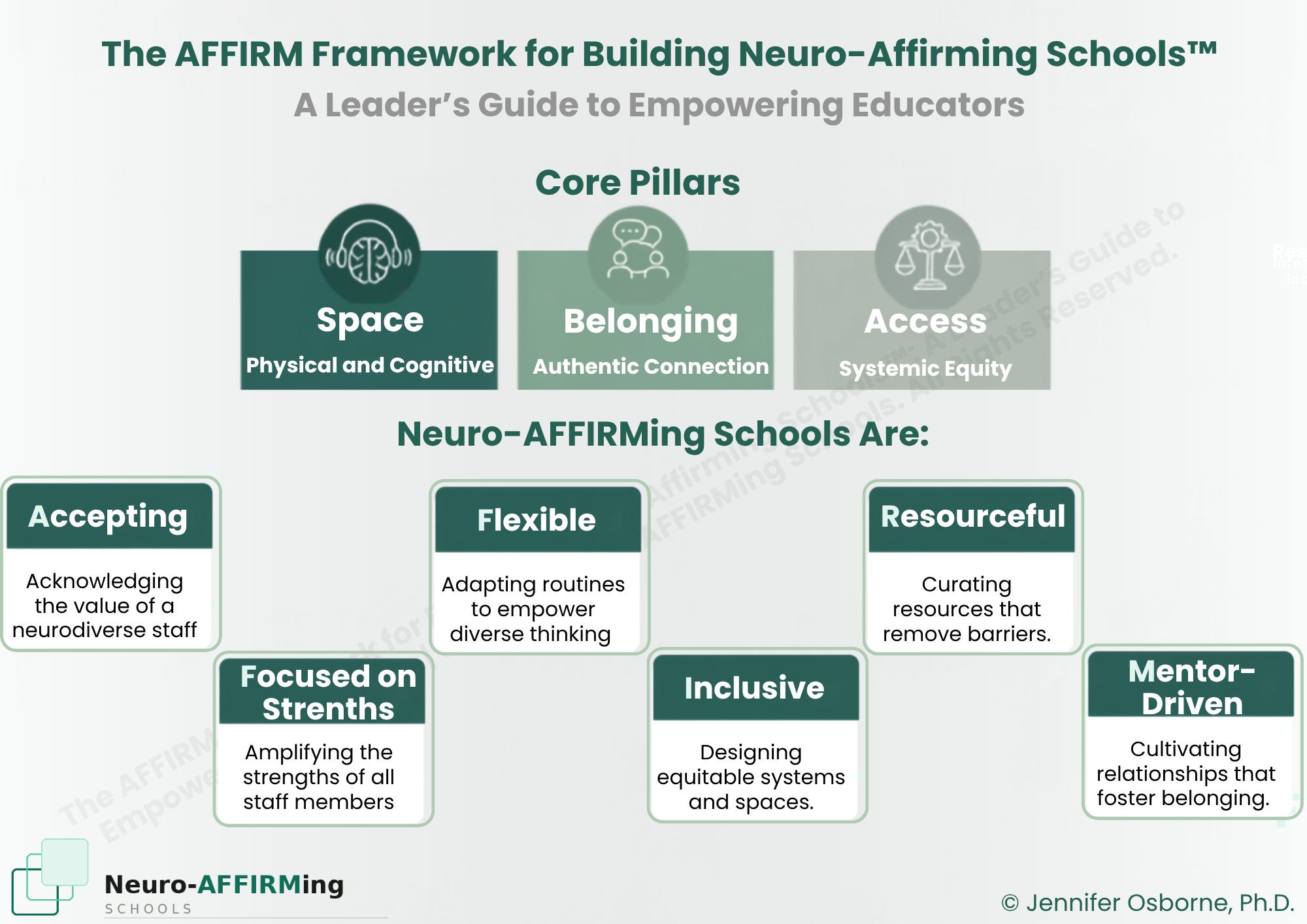
To positively disrupt schools, we revisit the AFFIRM Framework for Building Neuro-Affirming SchoolsTM to make sense of the current state and the research to design neuro-affirming schools that work for all minds.
One of the seven AFFIRM principles is Focused on Strengths. We have talked about this before in The Hidden Faculty: Why They Need Us.
A school is a team, and a good coach maximizes the strengths of the members of the team. It only makes sense to recognize the strengths of neurodivergent educators as proponents of active learning and student engagement.
To create Belonging in neuro-affirming schools (one of the three core pillars!), we need to make the systemic shift of identifying educator strengths.
Actionable Practices
Provide educators the opportunity to identify their classroom strengths at the beginning of the year via a survey, focus group, or PLC meeting. Then look out for these strengths when doing walkthroughs and observations
Highlight moments of student engagement and active learning during observation feedback opportunities
Ask educators to lead workshops or sessions focused on active learning and engagement
Create semesterly peer-observation opportunities for students to observe each other in action
These actionable practices are good for all educators. Recognizing how educators utilize their strengths in the classroom goes a long way in bolstering their sense of belonging and connection.
And when educators feel like they belong and are valued for their strengths, they tend to stay.
Get the Playbook: Building a neuroaffirming school culture? Subscribe to receive The Playbook for Designing Neuro-AFFIRMing Schools.
Enjoyed this deep dive?
This dissertation work is 100% free so it can support the community. If you find value here, please consider upgrading to a paid subscription as a voluntary donation.
Check out the foundational 3-part series, The Hidden Faculty,” exploring exactly who neurodivergent educators are and why we all benefit by their contributions in schools: Part I | Part II | Part III
About the Data: The findings shared in this post are adapted from Exploring the Experiences of Neurodivergent Educators in Schools, a dissertation study performed at Texas Tech University as part of my Ph.D. program.
Qualitative data are drawn from semi-structured interviews with 14 neurodivergent K-12 educators across the U.S.
References:
Blackburn, B. (2023). Managing neurodiversity in workplaces. Occupational Medicine, 73, 57-58. https://doi.org/10.1093/occmed/kqac142
Hickman, R. & Brens, M. (2014). Art, pedagogy, and dyslexia. International Journal of Art and Design Education 33(3), 335–344. doi:10.1111/jade.12067.
Neca, P., Borges, M.L., Pinto, P.C. (2020). Teachers with disabilities: A literature review. International Journal of Inclusive Education, 1-19. doi:10.1080/13603116.2020.1776779
Osborne, J. J. (2025). Exploring the experiences of neurodivergent educators in schools [Doctoral dissertation, Texas Tech University].
Thorpe, A. and Burns, E. (2016). Managers’ and teachers’ perspectives of dyslexic Teachers in the English and Finnish Further Education workforce: New insights from organisational routines. Oxford Review of Education, 42(2), 200–213. doi:10.1080/03054985. 2016.1157062.Blackburn, B. (2023). Managing neurodiversity in workplaces. Occupational Medicine, 73, 57-58. https://doi.org/10.1093/occmed/kqac142