

The Hidden Faculty: We Are Around Here Somewhere
Part I: Why neurodivergent educators remain “hidden” in schools and what we can do about it


This is Part 1 of a 3- part mini-series called The Hidden Faculty, a series focused on acknowledging the neurodivergent educators that are “hiding” in plain sight.
Before starting the series, I recommend reading the Welcome Post and The AFFIRM Framework for Building Neuro-Affirming Schools for additional context of the Neuro-AFFIRMing School Community.
“I’m here. I exist. And students like us exist.”
The Current State
Neurodivergent educators are “hiding” in plain sight. Even though it is believed that 15-20% of people are neurodivergent, there is a distinct lack of acknowledgement of the presence of these educators in schools.
In my dissertation that explores the experiences of neurodivergent educators, participants spoke of feeling disconnected and ignored simply because of the lack of education and understanding of neurodiversity and of neurodivergent individuals.
Before we can create neuro-affirming schools, we first need to accept that neurodivergent educators exist.
“Everyone is different, and we all have our different strengths…I’m a valuable teacher because of what I bring into the classroom”
The first step to creating neuro-affirming schools is to acknowledge that there are educators in the building who learn and process differently, and that’s not only okay, but that’s actually an advantage in classrooms and schools.
The Paradigm Shift
Here is the paradigm shift: neurodivergent educators exist in schools. That’s it.
Before we can make change, we need to come to an understanding that there are adults who learn and process differently in schools.
Researchers have found that teachers with learning disabilities are not acknowledged as an important source of expertise (Ferri et al., 2005).
In a comprehensive literature review of teachers with disabilities, Neca et al. (2020) noted that there is a lack of recognition of what these teachers bring to schools.
Because of the lack of research on neurodivergent educators, there is a gap in understanding of who these educators are and what they might need for support.
Without an understanding of this population, we are unable to create the policies and practices that are needed for teacher inclusion.
The Redesign
The AFFIRM Framework for Building Neuro-Affirming SchoolsTM starts with Accepting.
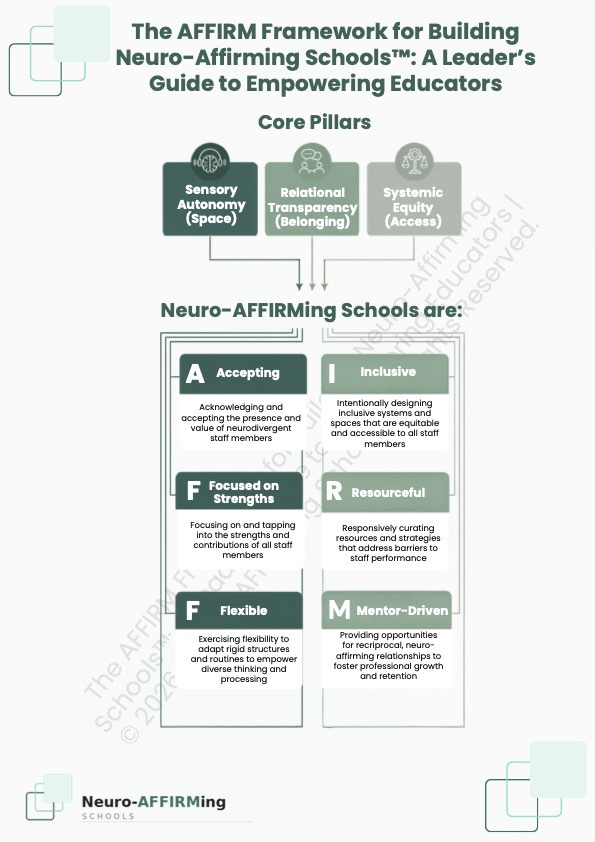
Acknowledging and accepting the presence and value of neurodivergent educators is essential to the design of a neuro-affirming school.
This framework rests on the premise that schools operate as they operate and sustainable change does not have to be an overhaul of current systems.
To support neurodivergent educators, we need to redesign and rethink current spaces and policies for the benefit of all educators.
In the spirit of simplicity, here are a few suggestions to acknowledge and accept the presence of neurodivergent educators in schools:
Invite guest speakers to educate all staff on neurodiversity and how neurodivergence benefits the school environment (Barnett, 2020)
When more staff members understand neurodiversity, they are more likely to exercise understanding when working with students and other educators
Create physical and cognitive spaces for neurodivergent educators to ask for support
Maintain an open door policy for conversations or create staff surveys that ask for the communication preferences of staff members
Design spaces where educators can escape the sensory overload of the school building
When there are safe spaces for expression, communication, and being, there is more likely to be understanding.
Create school-based groups that appeal to a wide variety of demographics to ensure all educators feel like they belong
This creates an opportunity to find mentors and colleagues for open-minded conversation and connection
This redesign is a cultural shift in thinking and will take some time to develop, and the success of these practices is highly dependent on the relationships in the building.
Do staff members feel comfortable asking for support? That’s the first step that leaders must take to support any educator.
If staff members do not feel like they have a space or that they belong, they will likely remain “hidden” in plain sight.
The first step to creating neuro-affirming schools is to acknowledge and accept the presence of neurodivergent educators.
Next up, Part II of The Hidden Faculty series: “The Hidden Faculty: The Cost of Fitting In (And Staying Invisible)”.
About the Data: The findings shared in this post are adapted from Exploring the Experiences of Neurodivergent Educators in Schools, a dissertation study performed at Texas Tech University as part of my Ph.D. program.
Qualitative data is drawn from semi-structured interviews with 14 neurodivergent K-12 educators across the U.S.
References:
Barnett, R.M. (2020). Leading with meaning: Why diversity, equity and inclusion matters in US higher education. Perspectives in Education,38(2), 20-35. http://dx.doi. org/10.18820/2519593X/pie.v38. i2.02
Ferri, B.A., Connor, D.J., Solis, S., Valle, J., & Volpitta, D. (2005). Teachers with LD: Ongoing negotiations with discourses of disability. Journal of Learning Disabilities, 38(1), 62–78.
Neca, P., Borges, M.L., Pinto, P.C. (2020). Teachers with disabilities: A literature review. International Journal of Inclusive Education, 1-19. doi:10.1080/13603116.2020.1776779