



This is Part II of Education, Disrupted: Systemic Shifts to Unlock Educator Strengths
Read Part I here.
New here? Check out the foundational series: The Hidden Faculty.
Get the Playbook: Building a neuroaffirming school culture? Subscribe to receive The Playbook for Designing Neuro-AFFIRMing Schools.
Now I know I’m on a different operating system, and things I emphasize and do well are just different (Osborne, 2025)
The Current State: Barriers to Disclosure
The sage on the stage. The one with all the wisdom. The master craftsman of all things learning.
There is a pervasive myth in our profession that teachers have to “know it all” or have to be “perfect.” If we make a mistake or act in a way that is different from other teachers, we must cover it up lest the students think we are a failure or incompetent in some way.
I wrote back in 2021 that we should let students make mistakes. After all, research shows us that students benefit from a growth mindset and making mistakes increases perseverance and resilience.
But what about for teachers? Are teachers allowed to make mistakes? Are teachers allowed to be different?
The participants in my study openly discussed the negative stigma associated with disability. For some of them, it meant not disclosing their neurodivergence for fear of being seen as “different” or “less than.”
While a majority of participants felt comfortable disclosing to students, parents, and administrators, there was a wide variety of reasons behind why they chose to disclose or not to disclose.
Some participants noted that students just don’t understand the nuances of disability, while other participants remarked that colleagues sometimes react negatively without even realizing they are doing so, making remarks similar to “well, you always seemed normal to me!”
Participants noted that when they felt safe in schools, they felt safe to disclose. Several participants noted they disclosed to parents in an attempt to let parents know that they understood their students because they themselves had the same challenges.
When schools are neuro-affirming, there is no need to try to be a “perfect” teacher. When schools are neuro-affirming, all teachers are recognized for their strengths.
Look, I’m not like everybody else; I do things a little differently, and I react a little differently (Osborne, 2025)
The Research: The “Faultless Teacher”
What was most striking in the literature on teachers with disabilities is this idea of a “faultless” teacher. Thorpe and Burns (2016) noted that there is an expectation of performance where a teacher has to be seen as perfect.
In fact, trying to be a “faultless” or “perfect” teacher is a barrier to a neuroaffirming school, leaving neurodivergent educators feeling like they will never succeed or meet the expectations. This also prevents neurodivergent educators from seeking support or disclosing that they need support for fear of leadership thinking that they are not capable of managing a classroom (Thorpe and Burns, 2016).
StEvens (2022) noted that autistic teachers are fearful of being pushed out of teaching if they disclose to other teachers with disabilities, stating that they are fearful of feeling vulnerable if their colleagues know of their challenges (Thorpe & Burns, 2016).
The “perfect” teacher does not exist, and we do a disservice to educators by expecting them to be faultless.
The Systemic Shift: Affinity Groups
To positively disrupt schools, leaders must examine how the current staff culture contributes to belonging.
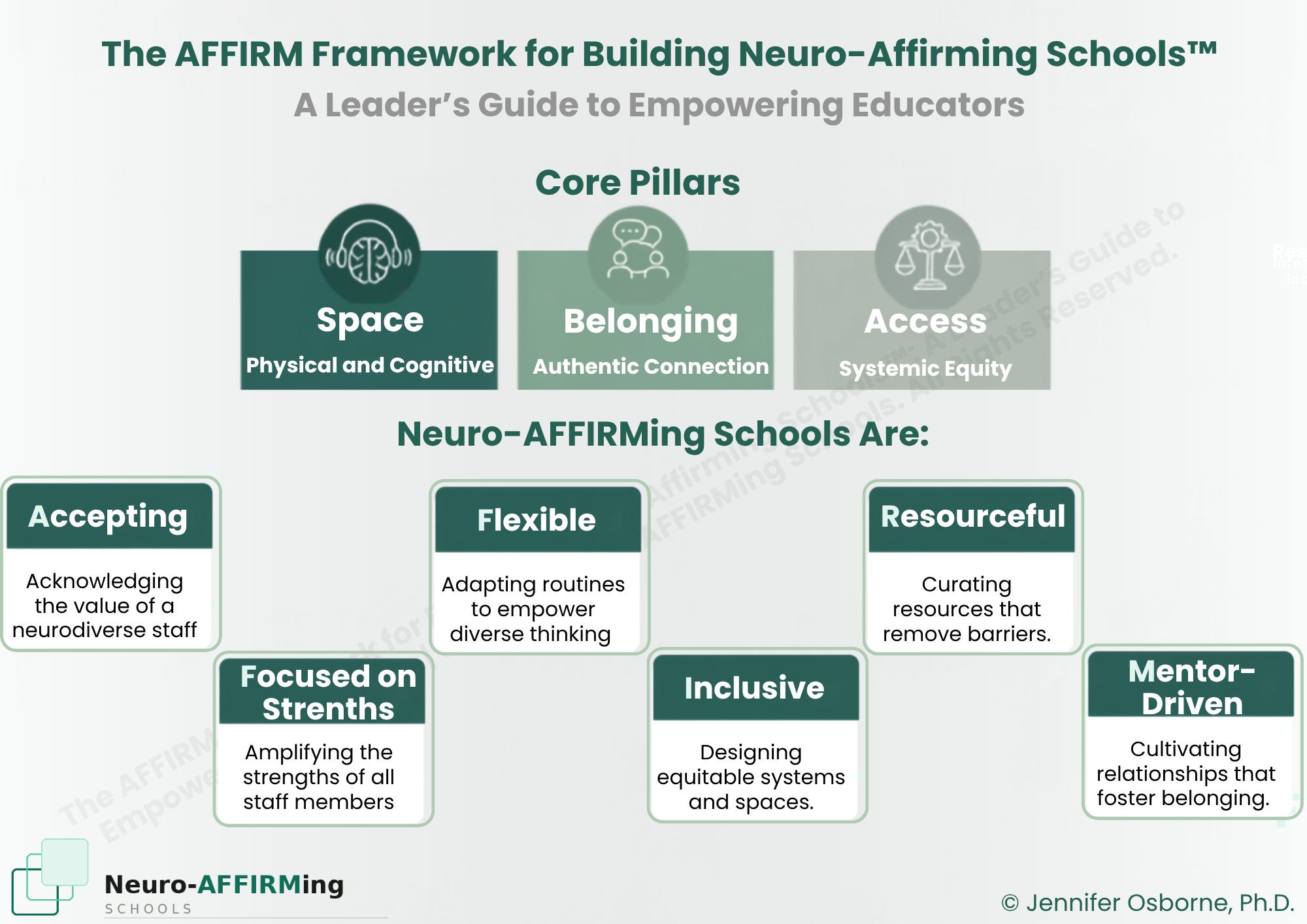
Mentor-Driven, or cultivating relationships that foster belonging, is an important principle in the AFFIRM Framework for Building Neuro-Affirming SchoolsTM.
For educators to feel like they Belong, they need to feel like they are accepted for who they are. This means ridding the school of the notion that teachers must be “perfect” or “faultless.” It’s simply not a reasonable expectation for anyone.
Whether neurodivergent educators choose to disclose is a personal choice; however, when schools embrace all types of processing and learning, it becomes easier to navigate the complexity of that choice.
One systemic shift is to create affinity groups that welcome and support educators, regardless of their differences.
Actionable Practices:
Create school-based affinity groups that meet quarterly to facilitate a sense of belonging and community
Provide opportunities for groups to present to faculty members, offering suggestions and asking questions to facilitate connection
Create space for affinity groups to contribute to school policy through surveys, focus groups, and teacher leadership sessions
These are small shifts in practice that can make a big difference in belonging at a school. Creating communities within a school benefits all educators.
Strong, diverse communities dispel the expectation of perfection.
Get the Playbook: Building a neuroaffirming school culture? Subscribe to receive The Playbook for Designing Neuro-AFFIRMing Schools.
Enjoyed this deep dive?
This dissertation work is 100% free so it can support the community. If you find value here, please consider upgrading to a paid subscription as a voluntary donation.
Check out the foundational 3-part series, The Hidden Faculty,” exploring exactly who neurodivergent educators are and why we all benefit by their contributions in schools: Part I | Part II | Part III
About the Data: The findings shared in this post are adapted from Exploring the Experiences of Neurodivergent Educators in Schools, a dissertation study performed at Texas Tech University as part of my Ph.D. program.
Qualitative data are drawn from semi-structured interviews with 14 neurodivergent K-12 educators across the U.S.
References:
Osborne, J. J. (2025). Exploring the experiences of neurodivergent educators in schools [Doctoral dissertation, Texas Tech University].
StEvens, C. (2022). The lived experience of autistic teachers: A review of the literature. International Journal of Inclusive Education: 1-15. https://doi.org/10.1080/13603116.2022.2041738
Thorpe, A. and Burns, E. (2016). Managers’ and teachers’ perspectives of dyslexic Teachers in the English and Finnish Further Education workforce: New insights from organisational routines. Oxford Review of Education, 42(2), 200–213. doi:10.1080/03054985. 2016.1157062.Blackburn, B. (2023). Managing neurodiversity in workplaces. Occupational Medicine, 73, 57-58. https://doi.org/10.1093/occmed/kqac142