
The AFFIRM Framework for Building Neuro-Affirming Schools
Creating schools where neurodivergent educators (and all) educators thrive


It is widely believed that 15-20% of the population is neurodivergent, which means nearly 1 in 5 Americans, or roughly 60 million people, are considered neurodivergent.
While it is logical to assume that there are educators in schools who are neurodivergent, this population seems to be “hidden.” There is a distinct lack of research and even more distinct lack of school policies around teacher inclusion.
While the movement to support neurodivergent students continues to gain ground, the adults that teach these students have been largely ignored.
Understanding Neurodiversity
The term “neurodiversity” was coined in the 1990s by Australian sociologist Judith Singer, and is defined as a subset of biodiversity, or the fact that all humans have a “unique nervous system with a unique combination of abilities and needs.”
Neurodiversity is considered a social movement that “seeks civil rights, equality, respect, and inclusion for all neurodivergent people.”
There has been some confusion about the terms in neurodiversity, especially the interchanging of the words neurodiverse and neurodivergent, so they are further defined below:
Neurodiverse- a group of both neurodivergent and neurotypical individuals; we are ALL neurodiverse; schools are neurodiverse
Neurodivergent- an individual whose brain processes and learns differently than what is considered “typical” (i.e., Autism Spectrum Disorder, ADHD, dyslexia, dyspraxia, etc.)
Neurodiversity-Affirming- an environment that acknowledges, accepts, and values neurodivergent individuals
A Need for Systems
After finishing my dissertation research on the experiences of neurodivergent educators, I have continued to reflect on how we can create environments that support these educators. As a systems-oriented person and current school leader, I have tried to balance the need with the reality.
School leaders are incredibly bogged down with a multitude of duties, which means we basically run around and put out fires all day while trying to support teachers, analyze data, and communicate with families, among many other responsibilities.
Administrators do not need one more thing. What administrators do need are systems. More importantly, systems that are easy to implement and sustain.
The Curb-Cut Effect
Since neurodiversity is a natural variation in how human brains work, it is our responsibility to ensure that environments are open and accepting of all minds. For students, we create sensory-friendly spaces and use frameworks such as the Universal Design for Learning to ensure equitable access to the school environment.
For adults, we expect educators to perform the same work in the same way at the same time. This is the rub when it comes to creating neuro-affirming schools. And this is when something called the curb-cut effect comes into play.
The “curb-cut effect” originated when Michael Pachovas and a few friends created a ramp on a curb to access a sidewalk with their wheelchairs. Despite police threatening to arrest them for pouring concrete on a curb, this sparked activism that resulted in the first “curb cut” on Telegraph Avenue in California in 1972.
Curb cuts created an interesting phenomenon. As Angela Glover Blackwell writes, “when the wall of exclusion came down, everyone benefited…parents pushing strollers…workers pushing heavy carts…[and] travelers wheeling luggage.”
The curb cut effect demonstrates that one small change to a system can have ripple effects that benefit an entire population.
In schools, there is an idea that we must treat teachers all the same–equality over equity. Blackwell states this very well: “there’s an ingrained societal suspicion that intentionally supporting one group hurts another.”
If we design special systems to support neurodivergent educators, how would that be fair to the rest of the staff? This is where the opportunity lies.
The Opportunity
How do we create environments that support neurodivergent educators while also benefiting all educators through sustainable systems?
The bottom line is that these educators exist in schools, and we need to support them just as we support our neurodivergent students.
Perhaps the best way to support neurodivergent educators is to support all educators by redesigning the school environment for all minds.
What is good for one can be good for all.
The Framework
Without further ado, here is the AFFIRM Framework for Building Neuro-AFFIRMing Schools.TM
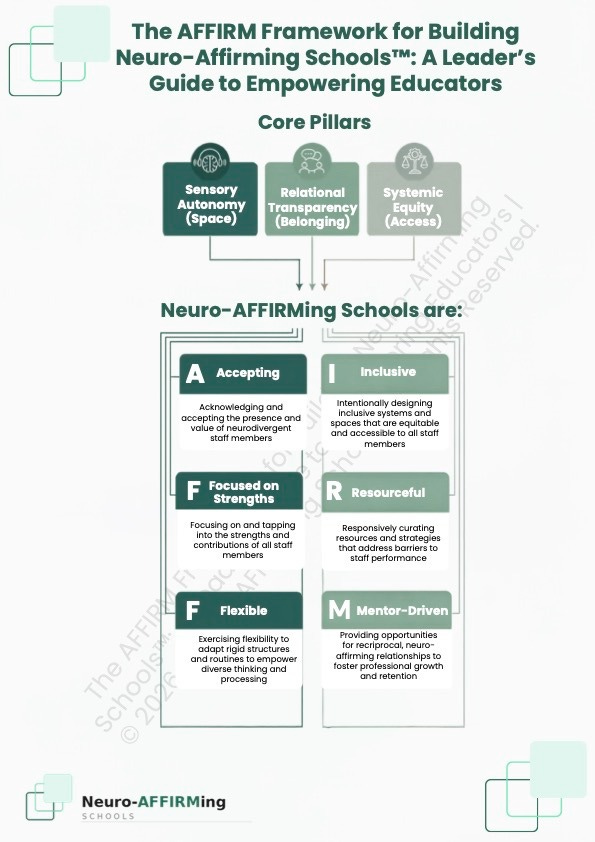
This framework is largely based on the data from the participants in my dissertation research, which was largely informed by empirical research on teachers with disabilities, the psychological needs of self-determination theory, and the tenets of neurodiversity.
This framework rests on three core pillars that address what all educators need:
Sensory Autonomy (Space): Educators need a physical and cognitive environment that works for their sensory needs (i.e., duty spaces, written and explicit expectations)
Relational Transparency (Belonging): Educators need clear communication channels and reciprocal mentorship.
Systemic Equity (Access): Educators need access to the profession through the hiring/onboarding/retention processes.
Residing within these core pillars are the AFFIRMing practices that schools exhibit when creating a neuro-affirming environment. Notice that these practices are simplistic in nature, but powerful in implementation.
As we navigate through the research on neurodivergent educators, we will continue to visit this framework as a lens for creating sustainable systems that benefit all educators.
When all educators benefit, all students benefit.
Ultimately, the mission of Neuro-AFFIRMing Schools is to help school leaders empower ALL educators by designing environments where neurodivergent educators thrive.
Recommended Reading: